ESEE student representative Laura Felício interviews Sarah Paquet
Tell us about yourself
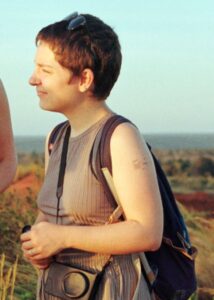
I’m Sarah Paquet, French student, in the 3rd year of my PhD. This PhD is funded by the Agence française de développement (AFD) as part of the VARUNA program on biodiversity conservation in the South-West Indian Ocean.
I work for the Institut de recherche pour le développement (IRD) within the UMR SENS (Savoirs, Environnement, Sociétés). I’m an agronomist engineer specializing in tropical forest management. I had an interest in the natural sciences before opening up to the human and social sciences, and I find that transdisciplinarity is central to questioning issues linked to ecological challenges. I’ve been lucky enough to travel a lot around the world, either as a tourist or as part of my job. I love talking to people, and I’ve always been interested in listening to them, trying to understand where their thoughts come from.
What are you researching?
I’m working on the perception of nature in Madagascar. But what is “nature”? What is “nature” for the Malagasy? What makes it important (or not)? The term “nature” doesn’t exist there, even if other words come close. My research addresses these questions in two ways:
- Study the effect of an exhibition on biodiversity awareness: is this type of tool effective for environmental education in Madagascar?
- Understanding the pluralism of values in a Madagascan protected area through the use of non-monetary approaches. The framework studied is that of intrinsic, instrumental and relational values. I use quantitative and qualitative methods in a context of so-called Global South. Within this area, I have conducted interviews with local populations, as well as implemented Q-methodology and participatory mapping workshops to better understand local people’s representation of nature.
My research is carried out within the framework of strong sustainability, and is part of the sustainability science.
How were you introduced to ecological economics?
During my engineering training, I was lucky enough to have a researcher in ecological economics give a one-week talk as part of a module in my course. Through case studies, I discovered my interest in this unknown discipline until then. I realized that I could see myself working on all the case studies presented. For me, a new idea had just emerged: the collapse of biodiversity is known worldwide, yet nothing changes (or very little)… What if we showed the values of this disappearing biodiversity to show society that without it, we’re lost?
If you were in charge of the world economy for one day, tell me one thing what you would do and why?
I’d never like to have that kind of responsibility. For me, you always have to be in dialogue with others, never act alone, never imagine that a solution that has worked somewhere can be copied elsewhere. So maybe one thing I’ll do is say that solutions have to emerge and be implemented locally, that’s what works. That the way the economy is organized and structured differs depending on the country and territory. In Madagascar, for example, most activities are undeclared/informal: subsistence farming or the sale of produce on the market, for example. That words have a meaning and are sometimes untranslatable, that sometimes things seem simple or obvious to us, but are complex to others, and vice versa. I’d say that, in the global economy, we need to think not just in terms of numbers, but in terms of a whole host of exchanges (material or otherwise) and flows, some (or even most) of which are incommensurable.
Tell me one thing that you think many ecological economists don’t realise, but should.
Do I have this legitimacy? Two weeks ago, I attended a conference on measuring tolerance to natural risks, given by an economist. When I asked whether non-monetary approaches existed for this type of study, the researcher’s response was: «economics is the science of money». I was astonished to hear this type of response even today… If that’s what economics was, I’ll tell you the truth, I wouldn’t like to work in this discipline. Also, at the previous ESEE conference, which I was able to attend, two points surprised me: the fact that the majority of the studies presented focus on so-called Global North, assuming that the same tools or conclusions are applicable to other contexts; and the low number of “innovative” methods with non-monetary approaches.
What’s next, any specific plans?
I want to continue in research! My aim is to do a postdoctoral research in another laboratory and another country. I’d like to learn more about values conflicts and environmental justice, why not using serious game approaches? They can be used to put the realities of the field into practice by getting the stakeholders in the area to talk to each other using a fun and interactive tool (board game, role-playing game …). Serious game might be another way of approaching value conflicts and collectively imagining compromises. Also, I’d like to continue doing fieldwork, and local studies. Don’t hesitate to contact me if these are issues you’re working on, I’d be happy to discuss about it!